How To Navigate Live Music Setup In San Diego Venues

Published October 22nd, 2026
Live music at upscale venues demands more than artistry; it requires precise orchestration of logistics and technical details to uphold the sophistication expected by discerning clients. In San Diego's premier event spaces, every aspect-from equipment load-in to sound calibration-must be planned with exacting care to preserve the venue's ambiance and align with strict operational protocols. Navigating constraints such as limited access points, venue-specific rules, and acoustic challenges calls for experience and foresight to ensure a performance that enhances the occasion without distraction.
Drawing on decades of international and Southern California engagements, Michael has refined a methodical approach that balances musical expression with practical coordination. This guide offers insights into the critical factors that influence setup and sound quality, empowering musicians, event planners, and luxury clients to create an atmosphere where live music integrates naturally and elevates the celebration.
Understanding Load-In Logistics for Upscale San Diego Venues
Load-in is the quiet engine behind a refined event. In high-end San Diego venues, the way equipment enters the property often determines how calm or chaotic the first hour feels for the planner, the couple, and their guests.
Parking is the first gatekeeper. Many luxury properties sit on busy streets or share access with hotel guests and valet services. Clear instructions on which entrance to use, where to stage a vehicle, and how long the loading zone is available prevent tense conversations with security and avoidable delays. Michael always requests written load-in notes from the venue coordinator rather than relying on memory from a site tour.
Vertical access comes next. Freight elevators, service corridors, and back-of-house hallways are often shared with catering and decor. A white piano shell, subwoofers, and lighting cases move slowly through narrow spaces, so realistic timing matters. Michael plans each trip assuming a wait for staff, room service carts, or another vendor, then builds that margin into the schedule.
Timing constraints in upscale properties tend to be strict. Banquet managers protect pre-function spaces from clutter, and housekeeping keeps guest corridors clear. Michael confirms exact access windows for ballrooms, terraces, and cocktail spaces, then works backward: arrival, first cart in, final repositioning, and only then sound check. Punctuality here is not a courtesy; it is a form of respect that keeps the wider event timeline intact.
Coordination with venue staff ties everything together. On arrival, Michael greets the banquet captain or event manager, confirms where cases may be stored, and clarifies which doors must remain closed for guest experience. That five-minute conversation often prevents a last-minute request to move gear during prelude or dinner service.
An efficient, well-sequenced load-in creates a calm foundation for equipment setup. When every cable, stand, and instrument reaches its position early and without drama, Michael can focus fully on refined stage layout, meticulous wiring, and an unhurried sound check. Mastering these logistics keeps the energy in the room where it belongs: on the celebration, not on the gear that supports it.
Navigating Venue Equipment Setup Constraints With Elegance
Once load-in runs on quiet rails, the true test begins: fitting a complete musical environment into a refined room without disturbing its design. Luxury venues often offer grandeur in volume height and finishes, yet provide surprisingly modest footprints for the band or soloist.
Space is the first constraint. Banquet diagrams favor guest tables, circulation paths, and floral installations, which leaves compact, irregular corners for music. Before arrival, Michael studies the floor plan and orients the setup so that sightlines to key focal points remain open. Michael aligns the piano shell parallel to the room's natural axes, keeps speaker stands tight to the back line, and avoids hardware that protrudes into guest pathways.
Power access shapes the next layer of decisions. In many ballrooms and terraces, outlets sit far from the preferred performance area or share circuits with lighting and catering equipment. During load-in, Michael traces actual outlet locations, confirms circuit sharing with the banquet manager, and routes a single, well-managed power run to a discreet power strip. This reduces cable clutter and minimizes the chance of tripping breakers mid-performance.
Aesthetics then guide every visible detail. High-end properties invest in finishes; exposed cables and bulky cases undermine that investment. Michael uses low-profile black cables taped along baseboards or hidden beneath rugs, keeps power bricks off the floor on small risers, and positions pedal boards behind the piano shell. Any necessary stands sit in symmetrical positions, and Michael avoids branded or visually noisy hardware whenever possible.
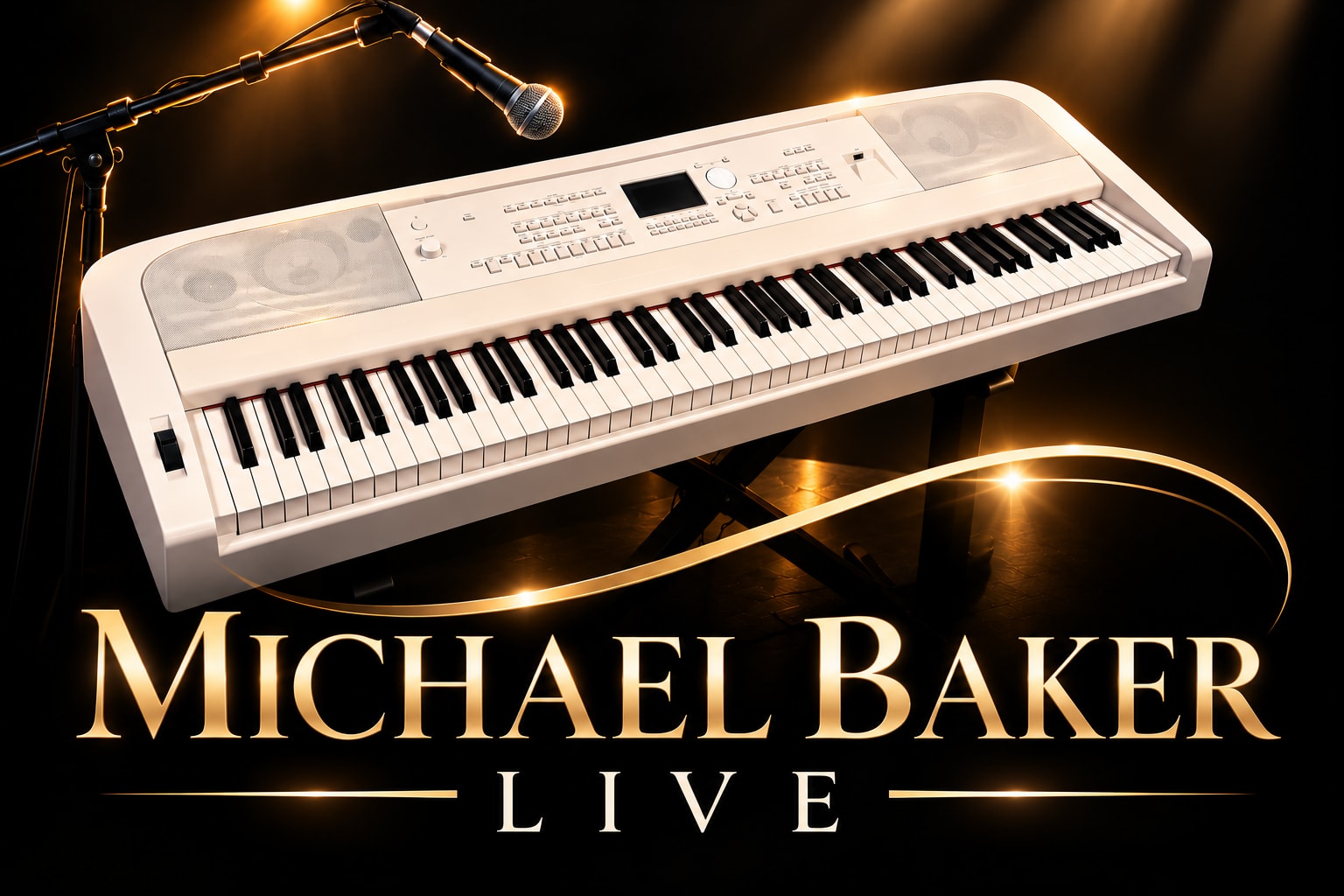
Instrumentation plays a decisive role in both elegance and efficiency. A white digital grand piano paired with professionally arranged backing tracks replaces an array of amplifiers, keyboards, and rhythm players while maintaining the depth of a full ensemble. This approach reduces the number of speakers, shortens sound checks, and preserves clean lines across the stage area. Because the digital piano contains internal sound shaping and recallable presets, Michael adjusts tone and volume for cocktail hour, and reception without re-cabling or moving gear.
The groundwork laid during load-in supports all of this. When cases reach the room in the right order-stands, piano shell, speakers, then finer elements such as microphones and in-ear monitors-setup becomes a quiet, deliberate sequence instead of a scramble. Michael can focus on precise speaker angles, subtle lighting on the piano, and cable paths that respect both the venue's architecture and the planner's design board. Technical discipline then fades into the background, leaving guests with the impression that the music simply belongs in the room.
Mastering Sound Checks for Flawless Acoustic Performance
A refined setup still needs one decisive step before guests arrive: a disciplined sound check that respects the room, the timeline, and the venue's standards. In San Diego's premier properties, this process often happens under tight access windows and strict noise guidelines, so planning each minute matters.
Michael starts by negotiating a sound check window with the planner and the venue coordinator that sits clear of guest arrival and housekeeping turnovers. For ballroom weddings, this often means finishing full-volume checks before prelude music begins and reserving only subtle level trims during guest seating. On terraces or rooftop spaces with neighborhood sound ordinances, Michael confirms decibel limits and curfews in writing, then builds gain structure around those boundaries rather than testing them.
Early contact with the in-house engineer or preferred sound professional sets the tone. Michael shares the input list-lead vocal, digital piano stereo feed, and backing tracks-and clarifies who controls main system volume once the event starts. During sound check, Michael adjusts channel gain and EQ from the musician's perspective, while the engineer walks the room to confirm that clarity and warmth reach the back tables without overpowering the front row.
Microphone placement becomes the fine brushwork. Michael positions the vocal mic just off-center to avoid direct breath noise and aligns it slightly above mouth level to reduce plosives while retaining presence. The piano's stereo output runs directly to the mixer, so Michael focuses on gain staging: digital piano master around its sweet spot, channel gains set conservatively, and faders riding the final balance rather than compensating for hot inputs.
Backing tracks require particular discipline. Michael routes them to a dedicated stereo channel and builds their level under the live piano and vocal, not on top of them. During sound check, Michael runs a full chorus of an upbeat track and then an intimate ballad, listening for how low-end energy behaves near glass walls, marble floors, or high ceilings. If reflections smear the mix, Michael pulls a touch of low-mid from the tracks and narrows speaker toe-in so energy points toward the dance floor rather than the side walls.
Common acoustic challenges in high-end Southern California rooms often come from hard surfaces and irregular shapes. Michael counters this during sound check by walking the perimeter: first along the back wall, then between tables, and finally at the bar or terrace railings where guests linger. Where bass buildup appears, Michael trims low frequencies on the main mix instead of chasing it with volume dips song by song. Where the top end feels sharp under chandeliers or near windows, a modest high-frequency cut on the main EQ restores comfort without dulling articulation.
Every adjustment during sound check closes the loop on the earlier equipment setup. Speaker angles, height, and distance from the nearest wall shift by inches, not feet, yet those changes often decide whether the vocal floats above conversation or competes with it. Michael refines monitor levels until singing and playing come with ease at the volume the room will actually experience, not at rehearsal loudness. Once the system feels balanced, Michael logs key settings on the mixer or scene presets so that any accidental bump during room flips or staff movement can be corrected quickly.
When sound check is treated as a quiet rehearsal for the entire event environment, not just a volume test, the payoff is felt hours later. The first note of the evening carries without harshness, cocktail conversation rides comfortably over background sets, and the reception opens with a mix that feels intentional rather than improvised. That invisible preparation is what allows the music to disappear into the celebration while still shaping how guests remember the night.
Adhering to Venue Noise Guidelines Without Compromising Performance
Noise control is not an afterthought in high-end San Diego venues; it sits beside décor and service as a core standard. Ballroom doors may buffer the sound, but neighbors, hotel guests, and outdoor terraces remain part of the equation. A flawless live performance in San Diego respects those limits without letting the music feel restrained.
Most luxury properties follow three main guardrails: decibel caps, time-based restrictions, and physical sound containment. Decibel caps usually differ between indoor ballrooms and outdoor spaces, with lower thresholds for terraces and rooftops that face residential streets. Time restrictions often step down in stages: higher levels allowed through dinner, then moderated volume for late-night dancing, followed by a hard curfew when amplified sound must cease. Physical containment may involve keeping certain doors closed, angling speakers away from property lines, or limiting subwoofer use outdoors.
Clarity begins long before the first note. Michael asks the venue coordinator and planner for written venue noise guidelines, including any agreements with neighbors or property management. Michael confirms who has final authority on volume decisions, whether a banquet manager, in-house engineer, or security. That shared understanding avoids tense discussions mid-reception and lets every professional in the room protect the same standard.
Once parameters are clear, Michael translates them into concrete musical choices rather than one blunt volume cut. For dinner sets, Michael prioritizes tonal balance and articulation over sheer level: vocal presence, defined piano mids, and restrained low-end energy. During dance sets in stricter environments, Michael adjusts arrangements to rely more on rhythmic clarity and less on sub-bass weight, so the room feels alive while readings at the property line remain compliant.
Equipment setup is where preparation carries the most weight. During load-in, Michael selects speaker positions with noise control in mind, not just coverage. Indoors, that often means raising speakers to ear height and aiming them across the room instead of into reflective walls. Outdoors, Michael toes speakers in toward the dance floor and away from open edges, then reduces subwoofer output or runs high-pass filters so low frequencies do not spill down streets or across courtyards.
Sound check then becomes a rehearsal against those boundaries. With a decibel meter or venue-provided monitoring, Michael establishes reference levels for three real-world scenarios: ceremony or prelude, dinner, and peak dancing. Michael notes mixer positions that achieve each target so a quick move between them is possible if a manager requests an adjustment. Instead of turning the entire system up and down, Michael sculpts specific elements: trimming track low-end by a few decibels, pulling the vocal slightly forward, or easing off high frequencies that carry far beyond the room.
Experienced musicians treat these limits as creative framing, not a constraint. Subtle dynamic control within songs-reducing intensity during verses, reserving full impact for choruses, and spacing high-energy numbers-allows the event to breathe while staying within venue expectations. Guests feel energy rise and fall naturally, planners see their timeline respected, and property management hears a performance that honors both ambiance and ordinance.
Key Offerings: Types of Events and Venues Michael Baker Live Elevates
Years of work in refined rooms have shaped how Michael approaches each event. The constant thread is a solo performance that feels bigger than one musician: live vocals and piano on a white Yamaha digital grand supported by discreet full-band backing tracks. That combination delivers the depth of an ensemble while preserving the clean footprint and quiet setup of a single artist.
Weddings sit at the center of Michael's calendar. Michael treats each portion of the day as its own stage: lyrical piano and voice for cocktail hour, nuanced background textures for cocktail hour, and a more rhythmic, dynamic approach for dinner and dancing. The digital grand moves gracefully from gentle ballads over dinner to confident, full-bodied arrangements that fill a ballroom without overwhelming conversation.
Luxury corporate gatherings call for a different kind of presence. In board dinners, investor events, and brand celebrations, Michael maintains a polished, understated soundscape that supports executive remarks and presentations. Because the piano, vocal mic, and tracks share one integrated system, Michael can shift quickly between atmospheric instrumentals, recognizable classics, and focused walk-on or walk-off cues for speakers.
Exclusive private parties and high-profile celebrations often unfold in architecturally distinct spaces: penthouse residences, galleries, members' clubs, or terrace lounges. Here, the compact scale of a soloist with a digital grand becomes an advantage. Michael adapts volume and style room by room, guiding the music from refined arrival sets into more energetic late-evening performances while keeping equipment visually aligned with the décor.
Across San Diego's premier venues-ballrooms, coastal resorts, estates, and rooftop terraces-the constant aim is the same: a musical atmosphere that feels intentional, elegant, and precisely coordinated with the flow of the event.
Michael Baker: Biography and Musical Journey
Michael Baker Live is a premium live entertainment experience in San Diego, presenting a solo vocalist and pianist for upscale weddings, corporate events, and private celebrations across Southern California. As a lifelong singer and musician, Michael draws on decades of international performance to design music that feels both intimate and expansive.
The story began as a boy in Paris, standing before a grand piano in a hotel window on the Avenue des Champs-Élysées. After receiving permission to play, Michael settled onto the bench and offered songs by The Beatles and Elton John. Within minutes, the lobby filled with guests and passersby who lingered, listened, and turned an ordinary afternoon into an impromptu concert. That moment fixed one idea in Michael's mind: live music should invite people closer without demanding attention.
Seven years living and performing across Europe refined that lesson. Evenings at the Hotel InterContinental Prague, engagements in distinguished hotels in Paris and Lake Garda, and a wedding at Rome's historic Sant'Onofrio taught Michael how architecture, acoustics, and culture shape every note. Michael learned to adjust touch and tone for marble floors, vaulted ceilings, and candlelit chapels, and to read the room long before the first song.
Since returning to Southern California, Michael has brought that sensibility to hundreds of weddings, corporate gatherings, private parties, restaurants, and clubs. The current format-a white Yamaha digital grand piano, expressive live vocals, and professionally arranged full-band backing tracks-grew from a practical goal: create the richness of an ensemble while keeping the footprint, setup time, and visual profile suited to refined venues.
That combination of artistry and logistics sits behind every technical decision described in this guide. Years spent moving pianos through service corridors, aligning sound with venue guidelines, and coordinating with planners and banquet managers inform each recommendation, so that high-end event music setup in San Diego feels as composed as the performance itself.
ADA Widget Integration for Enhanced Accessibility
Accessibility belongs in the same conversation as acoustics, décor, and noise management. Premier venues welcome guests with varied abilities, and thoughtful planning respects that reality from the first digital touchpoint to the last note of the evening.
An ADA widget integrated into an event website or online program gives guests control over how they experience information: adjustable text size, contrast options, keyboard navigation, and screen reader support. When live music details, timelines, and seating information sit inside an accessible framework, guests who rely on assistive technology navigate the event with confidence.
For planners and hosts, treating ADA considerations as part of live music coordination rather than a separate task aligns the technical, aesthetic, and legal standards of refined events. The result is a celebration that feels intentionally inclusive, not merely compliant.
Mastering the complexities of load-in logistics, spatial and power constraints, sound check precision, and noise control guidelines elevates live music from mere background to an integral part of San Diego's most distinguished events. Each detail, from discreet cable management to nuanced volume calibration, contributes to an ambiance where music enhances without overwhelming. Michael's extensive experience navigating premier venues ensures that preparation and adaptability coalesce into performances that feel both effortless and richly textured. This refined approach allows the music to resonate naturally within the architecture and rhythm of your celebration, creating moments that linger in memory. For discerning clients and luxury event planners seeking a live music experience marked by elegance, technical finesse, and deep venue knowledge, you are invited to learn more about how Michael Baker Live can bring your next sophisticated occasion to life with artistry and grace.
Request Your Personalized Proposal
Share your event details, and Michael will respond promptly with availability, refined musical ideas, and a customized proposal crafted around your celebration.